WordPress Plugin Development Services
Build custom and secure WordPress plugins tailored to your needs with STL CodeScape. Enhance your website’s functionality through expert development & support.
Custom WordPress plugins engineered for performance, security, and a seamless editor experience
We build lean, secure WordPress plugins that load fast and feel native, giving your team intuitive Gutenberg controls—without the bloat or lock‑in you get from generic add‑ons. If you need to integrate a third‑party API, streamline a unique workflow, or add functionality your theme can’t handle cleanly, we’ll engineer it the right way—documented, testable, and future‑proof. You own the code, and your editors get a smooth, familiar experience.
Here’s what you can expect:
- Speed-first architecture: minimal dependencies, clean PHP/JS, performance budgets, and assets that load only when needed.
- Security by design: strict sanitization and escaping, capability checks, nonces, least‑privilege roles, and audit‑ready code.
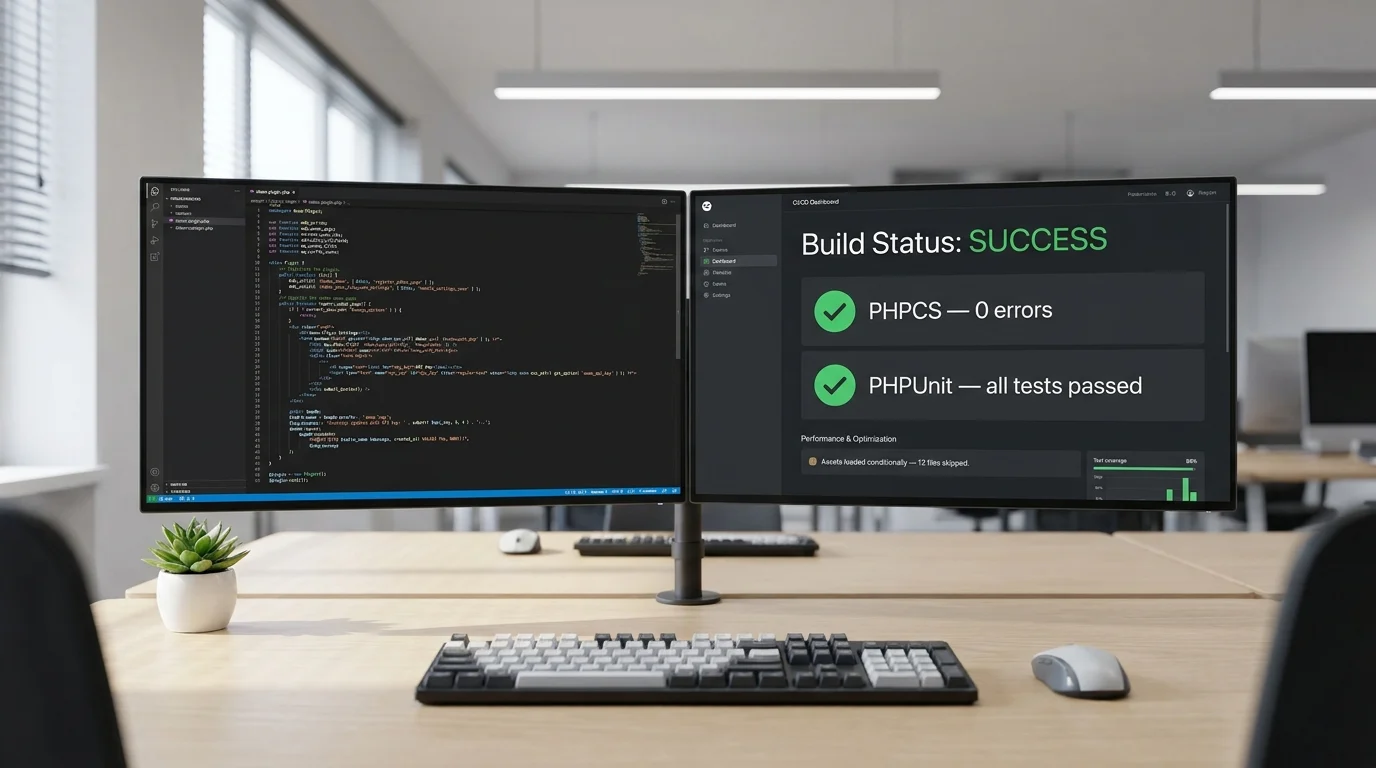
- Maintainable code: WordPress coding standards, Git version control, semantic versioning, automated tests, and clear docs your team can actually use.
- Seamless editor UX: custom blocks, fields, and settings that feel native to WordPress, so content editors move faster with fewer tickets.
- Long-term support: roadmap planning, updates, and iterative improvements so your plugin evolves with your site and business.
Start with a no‑pressure, 15‑minute consult. We’ll validate your use case, outline options, and provide a clear timeline and fixed‑scope estimate.
Request a plugin consult See our process
Prefer to talk it through? Call 314-657-7421 or email jc@stlcodescape.com.
Not sure if a custom plugin fits? Next, we’ll help you decide when to build versus extend an existing solution.
Is a custom plugin right for you?
Not every need calls for a from‑scratch plugin. We’ll confirm in a quick 10–15 minute discovery call and point you to the simplest, safest path—no pressure, no jargon. If a custom build isn’t the best move, we’ll tell you and suggest a smarter alternative.
A custom plugin is a good fit when:
- The feature is mission‑critical and you can’t risk a vendor dropping support or an update breaking it—your business stays in control.
- You have strict performance or security needs (sub‑second checkout, least‑privilege access, audit trails, or PII handling) and need provable compliance.
- Your workflows are unique—approval chains, pricing logic, scheduling, or data modeling that off‑the‑shelf tools don’t match—so the tool should fit your process, not the other way around.
- You need specialized integrations (CRM/ERP, POS, inventory, shipping, SSO) with reliable two‑way sync, queuing, and failover handling to avoid data loss.
- You want better editorial tooling, such as Gutenberg blocks, streamlined admin screens, or guardrails for non‑technical users so your team can move faster with fewer mistakes.
Smart alternatives we may recommend (to save time and budget):
- Extend a solid, well‑supported plugin via hooks/filters or a small add‑on.
- Tune what you already have by adjusting settings, trimming bloat, or consolidating overlapping plugins.
- Ship targeted code snippets or a small must‑use plugin for narrow tasks.
- De‑scope nonessential features or use a SaaS via webhooks/API to keep complexity down.
Why teams choose a custom build with us:
- No‑bloat performance: minimal dependencies, efficient queries, and fast admin screens.
- Clean, maintainable codebase: WordPress standards, namespacing, testing, and documentation.
- Full ownership and control: your IP, your repo, clear release notes, and semantic versioning for predictable long‑term maintenance.
Want a straight answer on custom vs. off‑the‑shelf? Book a quick discovery call and get a recommendation, a rough scope, and timeline. Call 314-657-7421 or email jc@stlcodescape.com.
If custom is the right move, here’s what we build and how we keep it fast, secure, and easy to use.
What we build
From lightweight utilities to enterprise integrations, we deliver only what your site needs, without lock‑in. You keep full code ownership and a roadmap you can grow. If it won’t move the needle, we won’t build it.
-
Custom plugins from scratch focused on business logic and speed
Purpose‑built plugins that match your workflows and scale cleanly. We favor lean architecture, minimal queries, object caching, background queues (Action Scheduler), WP‑CLI commands, and REST endpoints or webhooks. Features feel instant, even under load. Ideal when you’ve outgrown marketplace plugins or need proprietary logic. Want to validate fast? We can start with a small proof‑of‑concept.
-
Plugin customization and feature extensions to existing tools
Add what’s missing without touching core files. We extend via hooks/filters, custom add‑ons, and safe overrides to keep updates smooth and compatibility intact. Quick wins without a full rebuild.
-
API integrations and data sync (CRMs, ERPs, payments, marketing automation, webhooks, OAuth)
Two‑way sync with systems like Salesforce/HubSpot, NetSuite/Acumatica, Stripe/Authorize.Net, ShipStation, Marketo/Klaviyo, and custom SaaS. We implement OAuth 2.0, signed webhooks, rate‑limit handling, retries/backoff, field mapping, validation, and encrypted secret management—so data is where it should be, when it should be. Have a platform not listed? Send the docs and we’ll confirm feasibility on a quick call.
-
WooCommerce extensions (checkout, pricing rules, subscriptions, fulfillment)
Tailored commerce logic: custom checkout steps and fields, dynamic pricing and promotions, bundles/kitting, subscriptions and proration, multi‑currency/tax, HPOS compatibility, inventory/WMS/ERP sync, and RMA/refund flows. Outcome: smoother checkout, fewer support tickets, more revenue per visit.
-
Gutenberg blocks, patterns, and admin UX improvements
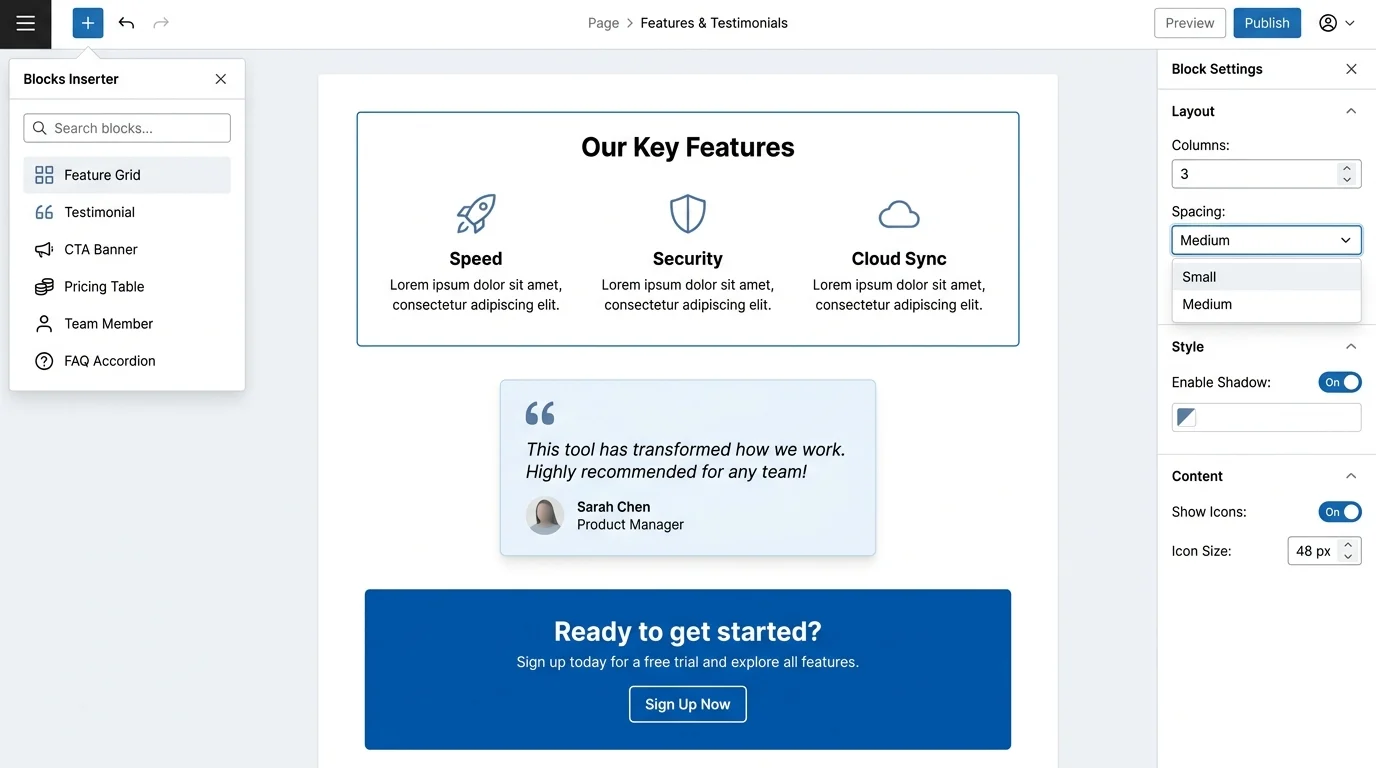
Editor experiences your team will actually use: reusable Gutenberg blocks and patterns aligned to your content model, server‑rendered blocks for dynamic data, intuitive settings pages, role‑based capabilities, dashboards and reports, contextual help, and accessible, RTL‑ready interfaces. Reduce publishing time and keep content on brand. Want a quick demo of blocks tailored to your content? Just ask.
-
Migration and compatibility updates (PHP/WP versions, deprecated APIs)
Modernize legacy plugins for PHP 8.x and WordPress 6.x. We replace deprecated APIs and jQuery patterns, fix autoloading and namespace issues, adapt for the block editor and REST permissions, and add shims for backward compatibility—avoiding surprise breakage during updates.
-
Multisite and multilingual considerations
Network‑aware settings with per‑site overrides, cloning and sync scripts, shared vs. site‑specific tables, and robust WPML/Polylang integrations with proper gettext strings, hreflang, and localization for currency and measurements. Confidently scale across regions and brands.
-
Documentation, training, and handover
Clear READMEs and usage guides, in‑code docs, architecture notes, semantic versioning and changelogs, plus live or recorded training for editors and admins. Prefer a clean handoff? We’ll enable your team—or roll into our ongoing management program.
Talk through your use case: 314-657-7421 or jc@stlcodescape.com. Book a 20‑minute scoping call and we’ll validate the fastest path to value—custom build, extension, or integration—and share a practical ballpark and timeline within 1–2 business days. Prefer to start small? Ask about a fixed‑price discovery sprint.
Every deliverable follows our engineering standards: performance budgets, security reviews, coding standards, and automated testing. We outline these next.
Our engineering standards
We treat plugins like products: clear architecture, measurable performance, and code your team can trust—built to last and easy to hand off. Whether you’re enhancing WooCommerce, integrating a third‑party API, or replacing a bloated add‑on, we’ll meet you where you are and move fast without cutting corners.
Code quality and architecture
- WordPress coding standards (PHPCS) in CI, modern PHP (8.x), namespacing, and selective OOP where it improves clarity and testability.
- No global pollution. We encapsulate code with prefixes or namespaces and expose functionality via clear actions and filters.
- Admin UIs feel native to WordPress, with thoughtful settings and Gutenberg block or pattern support where it makes sense.
- Outcome: predictable code reviews, fewer regressions, and a plugin your team can safely extend.
- Have an existing codebase? We can inherit and stabilize it—ask for a quick audit.
Performance budgets
- Each feature has a budget: optimized queries (avoid n+1), a caching plan (transients/object cache), and asset budgets with bundling and code‑splitting so scripts and styles load only where needed.
- We minimize autoloaded options, keep dependencies small, and queue or debounce background work to keep TTFB low and the admin responsive.
- Result: faster load times without sacrificing features—great for SEO and conversion.
- Want a baseline report? We’ll profile your current plugin and share quick wins.
Security first
- Nonces, capability checks (current_user_can), sanitization and escaping, and prepared statements ($wpdb->prepare) wherever user input or queries are involved.
- Safe file operations via WordPress helpers, least‑privilege file permissions, and secret management via environment variables or wp‑config, not the database or repo.
- Defense in depth against CSRF, XSS, and SQLi, plus third‑party SDK reviews before inclusion.
- Peace of mind for regulated or high‑traffic sites—happy to sign NDAs and align with your infosec checklist.
Compatibility and releases
- Backward compatibility by default: graceful fallbacks, feature flags, and deprecation notices with timelines.
- Semantic versioning (MAJOR.MINOR.PATCH), human‑readable changelogs, tagged releases, and documented upgrade routines with tested rollbacks.
- You get safe, scheduled releases and zero‑drama rollbacks. Ask for a sample changelog.
Accessibility (WCAG)
- WCAG 2.1 AA where applicable: semantic markup, keyboard operability, focus states, ARIA labeling, clear error messaging, and sufficient color contrast.
- Better UX for everyone, fewer legal and brand risks.
Workflow and environments
- Git workflows with feature branches and required code review. Automated checks (PHPCS/PHPStan/ESLint) on every pull request.
- CI/CD builds and versions assets, runs tests, and deploys to staging for UAT before production.
- Staging mirrors production (PHP/WP versions, caching, and search/CDN where relevant) for realistic validation.
- Clear checkpoints and demos so stakeholders can sign off with confidence.
Testing matrix
- We test against supported PHP versions (8.0–8.3+), current and previous major WordPress releases, and both single site and multisite.
- Browsers: current Chrome, Firefox, Safari, and Edge on desktop and mobile, plus assistive tech checks for key flows.
- Cross‑compatibility with your theme and critical plugins (WooCommerce, SEO, caching/optimization) is part of QA.
- Launch knowing what’s covered—and what’s out of scope.
Documentation and extensibility
- Every plugin includes a README with setup, usage, capabilities and roles, settings, and troubleshooting.
- Inline docs and PHPDoc for public methods, plus a documented hooks and filters reference with examples so your team or vendors can extend safely.
- Release notes and a living CHANGELOG explaining what changed and why.
- Your team won’t be guessing—everything’s documented for smooth handoffs.
These guardrails are built into how we work—and they translate to predictable timelines and low‑risk delivery. Want this level of rigor on your plugin? Book a quick scoping call or email jc@stlcodescape.com. Prefer to start small? Request a 5‑day code and performance audit with prioritized fixes and a clear estimate. Call 314-657-7421 to get on the calendar.
How we deliver (our process)
Our projects follow a clear, testable workflow that ships fast without cutting quality—so you get predictable timelines, fewer surprises, and a plugin your team can trust. If you want to pressure‑test an idea before we dive in, ask for a quick discovery call and a sample deliverable.
Discovery
- We define goals, constraints, acceptance criteria, and success metrics together. That includes budget and timeline, hosting and data constraints, compliance needs, and measurable outcomes (sub‑200ms API responses, under 1s admin screens, fewer manual steps).
- Artifacts: a concise project brief, prioritized backlog, acceptance criteria matrix, and a preliminary risk register.
- Outcome: alignment from day one and a clear “definition of done” you can share with stakeholders.
Technical architecture
- We map data models (custom tables vs. postmeta/options), permission schemes, caching and invalidation, and background jobs.
- Admin UX wireframes for settings, workflows, and any Gutenberg blocks or patterns.
- Integration contracts for third‑party systems (OpenAPI/Swagger, webhook and event schemas, retry and backoff rules).
- Versioned architecture notes in the repo for long‑term maintainability.
- Outcome: an implementation blueprint that de‑risks build time and makes future changes cheaper.
Iterative development
- Short sprints with scheduled demos and feedback loops. You see working software early on a staging URL.
- Git‑based workflow, code reviews, and feature flags keep releases safe and incremental.
- Outcome: no big‑bang launches—just steady, visible progress and faster time‑to‑value.
QA on staging
- Automated checks where feasible: PHPCS, static analysis, unit and integration tests with the WP test suite, and basic end‑to‑end flows.
- Manual testing across supported WP/PHP versions, key browsers and devices, and your dependency matrix (for example, WooCommerce versions).
- Performance and security reviews: capability and nonce checks, input sanitization and escaping, dependency vetting, performance budgets, and load testing of critical paths.
- Outcome: issues caught before customers see them, with evidence in test reports you can keep.
Deployment plan
- Release candidate on staging with a runbook: database migration scripts with dry‑run, environment diffs, and a checklist.
- Semantic versioning with changelogs and human‑readable release notes.
- Rollback strategy: point‑in‑time backups, tagged releases, and one‑click revert steps. For public releases, we handle WordPress.org submission and guidelines.
- Outcome: boring release days—predictable, reversible, and well‑documented.
Handover
- Documentation pack: setup and config guide, hooks and filters reference, data schema, and admin quick‑start.
- Live training and recorded screencasts for your team.
- Knowledge transfer session and repository access. Code ownership and IP assigned to you.
- Outcome: your team stays in control—no vendor lock‑in.
Post‑launch
- Monitoring and alerts for errors, performance, and uptime, with log reviews during stabilization.
- A guaranteed bug‑fix window (typically 30 days) for issues against agreed acceptance criteria.
- Optional ongoing management for updates, compatibility reviews, and iterative enhancements.
- Outcome: a healthy plugin that keeps pace with WordPress, your stack, and your business.
Ready to map your plugin and get a fast, realistic timeline? Book a discovery call: 314-657-7421 or jc@stlcodescape.com. We’ll give you a clear path forward—even if you’re still scoping.
Next, how we handle integration‑heavy use cases like CRMs, ERPs, payments, and AI.
Integrations and data flow you can rely on
Your WordPress site connects to the rest of your stack. We build plugins that integrate cleanly and keep data moving, even when APIs wobble or traffic spikes—so ops can relax and customers never notice. If you’re stitching things together with brittle zaps or manual exports, we’ll replace that with dependable, auditable syncs.
Typical integrations include:
- Payments and billing: Stripe, Braintree, Authorize.Net, PayPal, tax services, invoicing
- CRMs and marketing: Salesforce, HubSpot, Marketo/Pardot, Klaviyo, Mailchimp
- ERPs and finance: NetSuite, Microsoft Dynamics 365, SAP Business One, QuickBooks Online
- Shipping and logistics: ShipStation, Shippo, EasyPost, UPS/FedEx/USPS, 3PL/WMS providers
Don’t see yours? We’ve likely wired it before—or we’ll build the connector. Send your wishlist to jc@stlcodescape.com.
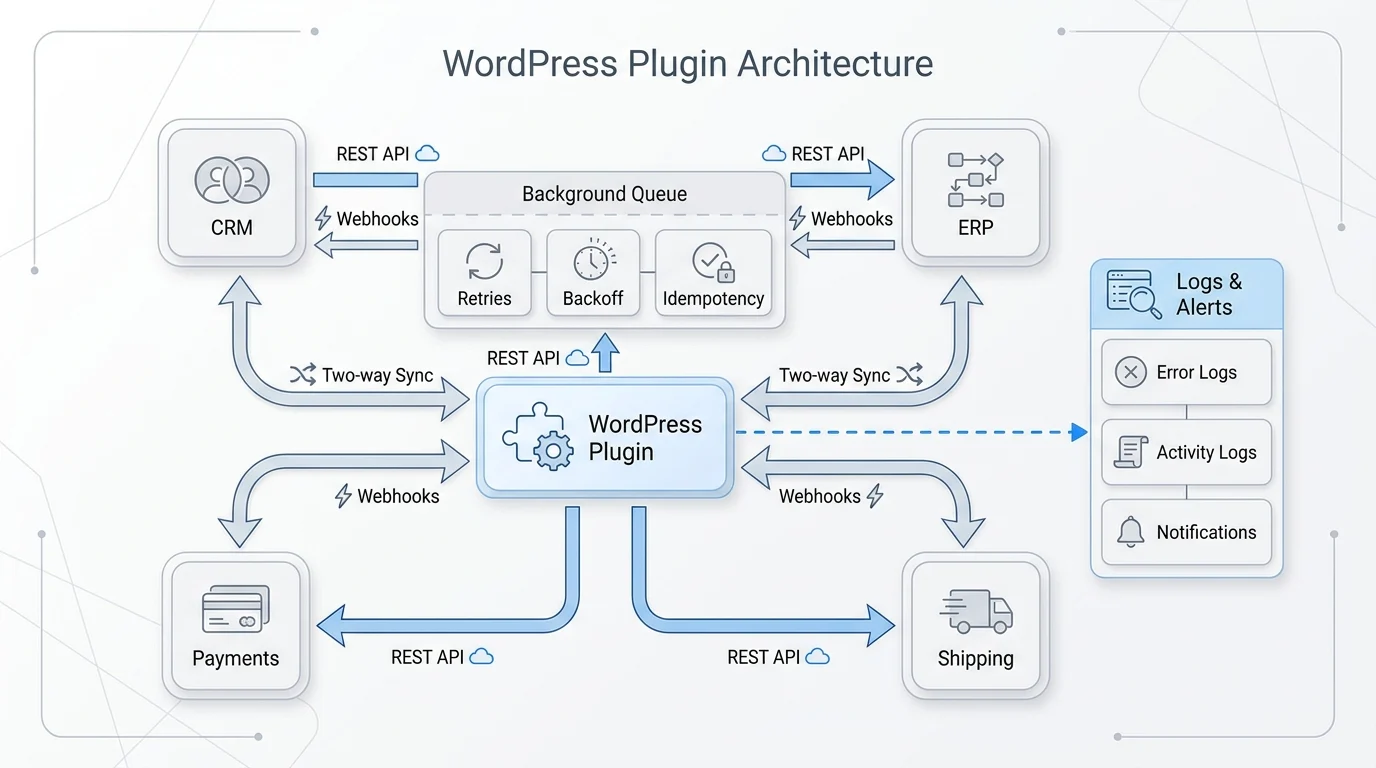
Reliable syncs
- Directionality you control: one‑way or two‑way flows with clear ownership rules, webhooks for real‑time events, and scheduled pulls for batch or rate‑limited endpoints.
- Queues and retries: background job queues (Action Scheduler) with exponential backoff, idempotency keys, deduplication, and dead‑letter queues for safe replays.
- Rate limiting and throughput: vendor‑aware throttling, concurrency caps, and pacing to respect API quotas without dropping data.
- Conflict resolution: version and timestamp strategies (ETags/If‑Modified‑Since), field‑level merges, and a human‑review queue when both systems edit the same record.
Result: fewer fire drills, accurate records, and happier teams. Want us to review your current syncs? Call 314-657-7421 for a quick sanity check.
Built‑in observability
- Structured logs: JSON logs with correlation IDs, request and response snapshots (sanitized), and per‑record sync history.
- Admin tooling: a wp‑admin dashboard for job queues, last sync times, error counts, and item‑level statuses, with one‑click replays and exports.
- Alerts and health checks: threshold‑based alerts to email or Slack, credential‑expiry warnings, webhook latency monitors, and error tracking (for example, Sentry).
You’ll see what moved, what didn’t, and why—before customers ever feel it. Ask for a 15‑minute demo: jc@stlcodescape.com.
Privacy‑first
- Data minimization: only the fields you need, with sensitive values masked in logs and encrypted at rest. Secrets live in environment variables with least‑privilege scopes.
- Retention controls: configurable TTLs for logs and payload archives, auto‑purge routines, and admin tools to honor right‑to‑erasure requests (GDPR/CCPA).
- Consent‑aware flows: respect CMP consent signals and subscription status, enforce opt‑in before marketing syncs, double opt‑in where required, and auditable consent trails.
- Secure exchange: OAuth2 where supported, rotating API keys, HMAC‑verified webhooks, and nonce and capability checks on admin actions.
These patterns power two common scenarios: eCommerce and editorial operations. Next, how we extend WooCommerce and streamline content workflows. Ready to connect your stack? Let’s talk: 314-657-7421.
WooCommerce and editorial experience
Stores and editors often need more than off‑the‑shelf add‑ons. We build lightweight WooCommerce extensions and editorial tools that convert better, run faster, and are easier to manage—without locking you into plugin soup. If you’re wrestling with a hard requirement or a messy checkout, let’s talk through it and outline the simplest path.
Custom WooCommerce logic
- Product types: bundles and kits, build‑to‑order, rentals, deposits and preorders, B2B price lists, and custom configurators.
- Dynamic pricing: tiered and volume discounts, customer groups, geo‑based rules, time‑boxed promos, and coupon logic that won’t collide with other plugins.
- Checkout UX: single‑page or multi‑step flows, address autocomplete, BNPL and gateways, custom fields and validations, and copy tuned to reduce abandonment.
- Inventory and fulfillment: multi‑warehouse stock, backorder rules, pick and pack status, ERP/WMS sync via APIs or webhooks, and reliable email or SMS notifications.
- Subscriptions: trials, proration, upgrade and downgrade flows, dunning and failed payment retries, and clear subscriber self‑service.
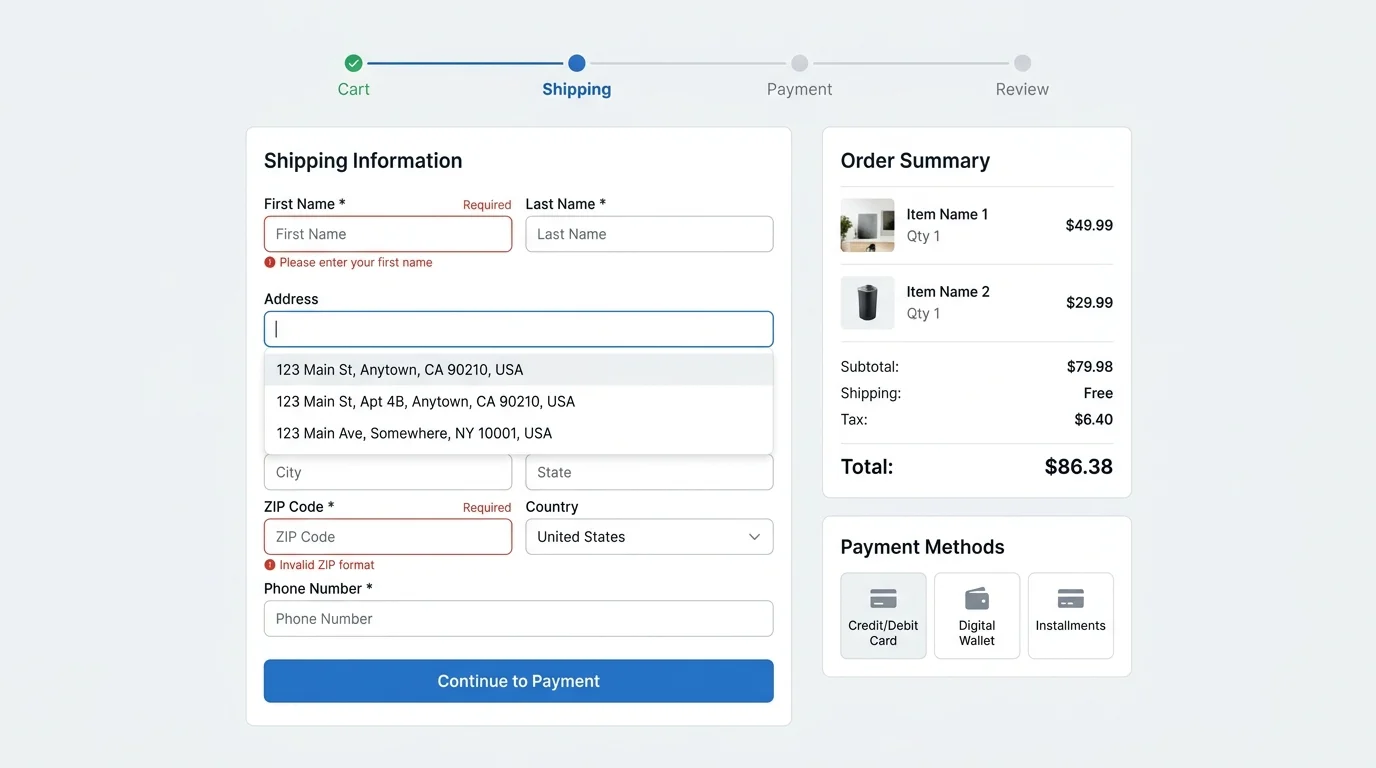
Results you’ll feel: higher AOV, fewer support tickets, and settings your team can actually use—documented and tested for edge cases.
Built for traffic and spikes
- Caching strategy: page, object, and fragment caching designed around cart and checkout no‑cache rules, with targeted cache keys and smart invalidation on price and stock changes.
- Database performance: query profiling, selective indexes, optimized postmeta lookups, and dedicated tables when needed to avoid meta bloat.
- Async tasks: queues for inventory syncs, emails, exports, and third‑party API calls so customers never wait on background work.
Translation: stable carts, fast checkouts, and calm launch days even when traffic surges.
Gutenberg enhancements your team will actually use
- Custom blocks and patterns mapped to your design system for products, promos, and landing pages. No shortcodes or mystery settings.
- Block and template locking to keep layouts on brand, with role‑based controls so editors see only what they need.
- Intuitive settings with sensible defaults, contextual help, validation, and previews to cut trial and error.
So marketing ships on‑brand pages in hours—not sprints.
Editor enablement and fewer steps to publish
- In‑editor tooltips, inline help, and onboarding checklists.
- Pre‑filled metadata, image guidance and alt‑text prompts, and pattern wizards that turn briefs into publish‑ready pages in minutes.
Outcome: fewer tickets to dev and a cleaner, more consistent site.
Have a wishlist or a checkout you’d like to fix? Request a quick demo or a 20‑minute fit check: jc@stlcodescape.com or 314‑657‑7421.
Next, how we add AI responsibly, from product assistants to editor copilots, without sacrificing privacy or performance.
Safe, practical AI features inside WordPress
AI is most useful when it quietly removes friction—and never surprises your legal team or your budget. We add AI to WordPress as purpose‑built plugins that are fast, governed, and measurable, without locking you to a single vendor. Want to see it on your site? Ask us for a quick demo or a low‑risk pilot using your content.
Practical use cases we implement
- On‑site chat that answers from your content and docs, captures leads, and hands off to humans when needed (with CRM handoffs if you want)
- Content help in the editor: titles, meta descriptions, outlines, tone rewrites, and block or pattern suggestions your team can accept or tweak
- Semantic search that understands intent with explainable results your editors can tune
- Summaries for long posts, product specs, support tickets, or reports (TL;DR blocks and previews you can approve before publishing)
- Insights for marketers and editors: trending topics, content gaps, and support‑deflection analysis right in your dashboard
How we architect it (safe by design)
- Server‑side proxying of model calls, with secure key storage and rotation
- Per‑role token and usage limits, budgets, and rate limiting to control cost and abuse
- Caching, background indexing queues, and performance budgets to keep pages fast
- Fallbacks if a provider is slow or down: default search or FAQ responses, cached answers, or a graceful hide
- Observability: request logs, error monitoring, and retriable jobs with timeouts
Privacy and governance controls
- Explicit user and editor opt‑ins and clear disclosures, with consent hooks where required
- PII redaction and field‑level allow and deny lists before data leaves your server
- Retention settings for prompts and responses, plus encryption in transit and at rest
- Role‑based permissions mapped to WordPress capabilities, with audit logs
Model‑agnostic by default
- A pluggable adapter layer supports OpenAI or Azure OpenAI, Anthropic, or approved local models (for example, self‑hosted via Ollama) based on your data sensitivity, cost, and latency needs, without rewrites—switch providers without a rebuild.
Measuring what matters
- Tie AI to outcomes: chat to leads or orders, search to product views, assistive writing to time‑to‑publish and revision cycles
- Built‑in dashboards for token spend, provider uptime, acceptance rates for AI suggestions, and support‑deflection metrics—so you can prove ROI, not just activity
Explore AI Integrations See AI Chatbot Setup
Not sure where to start? We’ll scope a 2–4 week pilot that proves value with clear guardrails and roll‑back options. Call 314-657-7421 or email jc@stlcodescape.com to get a quick demo with your own content.
All AI work follows our performance‑first coding standards and security reviews. Next, how we harden plugins for compliance and handle WordPress.org submission and release workflows.
Security, compliance, and repository support
Security first. Every plugin we ship follows WordPress coding standards (PHPCS: Core/Extra/Docs) and proven hardening patterns: strict capability checks (current_user_can), nonces for state‑changing actions, thorough input sanitization and output escaping, prepared queries ($wpdb->prepare), validated file uploads, REST permission callbacks, and assets that load only where needed. We namespace and prefix everything to avoid conflicts, and we design least‑privilege roles and capabilities with graceful failure states. Want an expert pair of eyes on an existing plugin? Ask for a fast security posture review and prioritized fix list.
Independent assurance on request. For higher assurance, we arrange third‑party audits and penetration tests. Our toolchain can include SAST/DAST and dependency checks (PHPStan/Psalm, PHPCS, Composer audit, npm audit, WPScan), plus threat modeling and remediation reports you can share with stakeholders. Need an executive‑ready summary for procurement or the board? We’ll package clear findings and next steps—let’s line up a review call.
Compliance‑ready from the start. We build privacy by design and help you document it.
- GDPR/CCPA: data mapping, configurable retention, consent hooks (CMP integration), Do Not Sell/Share support, and privacy copy you can add to your policy.
- DPIA support: architecture diagrams, data flows, risk controls, and mitigation notes.
- Data subject rights: native integration with WordPress exporters and erasers (wp_privacy_personal_data_exporter/eraser), plus admin tools for access, deletion, and portability (CSV/JSON).
- Logging and audit trails: who did what and when, timestamped, role‑aware, with PII redaction and log rotation options.
If your legal or compliance teams need proof, we provide evidence packs and configuration snapshots tied to each control.
Third‑party extension vetting and isolation
- Security history, maintenance cadence, and license compatibility
- Code quality and test coverage
- Controlled loading, version locking, and conflict avoidance (namespacing, prefixed autoloaders)
- Sandbox patterns for external APIs (timeouts, retries, fallbacks) and safe degradation if dependencies are missing
Bring us your dependency list—we’ll flag risks, suggest safer alternatives, and isolate what must stay.
WordPress.org repository submission, handled
- We prepare your plugin for directory compliance (GPL‑compatible, no obfuscation, no unsolicited tracking, clear admin notices).
- We create validated readme.txt files (short and long descriptions, tags, Requires/Requires PHP, Tested up to) and all assets (icons, banners, screenshots, FAQs).
- We manage SVN logistics: slug reservation, trunk/tags/branches, stable tags, semantic versioning, changelogs, and Git‑to‑SVN CI so releases are one click.
We’ll coordinate with the plugin review team and keep your release cadence predictable—just send us your repo and goals.
Private or commercial licensing and updates
- Licensing models: GPL for public components, dual licensing, or commercial EULAs where appropriate, clearly documented, with code ownership retained by you.
- Update channels: private update servers, Composer/Private Packagist, GitHub/Bitbucket releases, S3 with signed URLs, or tools like Easy Digital Downloads or Freemius for license keys, activations, and subscriptions.
- Release hygiene: staged channels (beta and stable), rollback plans, integrity checks, multisite‑aware auto‑updates, and detailed release notes.
Not sure which path fits your roadmap and revenue targets? We’ll walk you through the trade‑offs and set up the right delivery pipeline.
This sets a secure, compliant foundation. Next, how our ongoing management keeps that bar high with proactive monitoring, updates, and fast response after launch. Ready to tighten up your plugin or get it into users’ hands the right way? Let’s talk: 314-657-7421 or jc@stlcodescape.com. We’re happy to sign an NDA and review your spec or repo.
Ongoing management and support
We don’t ship a plugin and disappear. STL CodeScape stays on as your ongoing partner—keeping your custom functionality fast, secure, and aligned with your business as WordPress evolves.
What ongoing management includes
- Updates and monitoring: We handle core, plugin, and server updates, watch uptime and error logs, and fix issues before they affect users—so you stay ahead of breakages.
- Performance tuning: Regular Core Web Vitals checks, database and query optimizations, cache reviews, and asset budget enforcement to keep pages fast and protect rankings and conversions.
- Security patching: Continuous vulnerability scanning, timely hotfixes for critical CVEs, WAF rules and hardening, daily offsite backups, and tested rollbacks—reducing risk and downtime.
- Release rhythms: Planned releases around WordPress core and major dependencies (for example, WooCommerce), with semantic versioning, staging QA, and low‑traffic deployment windows for smooth launches.
- Roadmapping and experiments: Quarterly sessions to prioritize new features, plus data‑driven iterations with event tracking, funnels, and privacy‑safe A/B tests—so you ship what moves the needle.
- Clear communication: SLAs with defined response times, monthly reports covering uptime, performance, security, and releases, and a single St. Louis‑based point of contact who knows your stack.
Need reliable hosting alongside management? See our Hosting Solutions or broader Web Hosting Company services.
Retainer options
- Flexible retainers include a proactive improvement budget for optimizations and minor features, plus rapid‑response coverage for incidents—predictable support without adding headcount.
- SLA examples: Critical issues acknowledged within 2 business hours and worked continuously until resolved, high‑priority fixes scheduled within 1 business day, planned enhancements batched into monthly sprints.
Ready to offload ongoing care? Start with a support plan or bundle it with development for a smooth launch‑to‑growth handoff. Call 314-657-7421 or email jc@stlcodescape.com to request a tailored plan or a quick consult.
Next, short, outcome‑focused case snapshots.
Selected results
A few recent, measurable outcomes from custom plugin work—built specifically for each client’s stack:
-
Regional retailer (8,000+ SKUs): Custom WooCommerce ↔ ERP sync replaced brittle CSV imports. Inventory sync cut from 15 minutes to 90 seconds, oversells down 93%, product page conversion up 11% in 30 days.
“We stopped babysitting spreadsheets and started trusting our stock numbers.” — Director of Operations, Regional Retailer
Ready to retire manual imports? We can scope a Woo ↔ ERP sync for your stack.
-
B2B SaaS: Gutenberg block library for campaigns and resources. Time to publish a landing page dropped from 3 hours to 35 minutes, zero dev tickets in the first 60 days, brand‑consistency fixes down 78%.
“Our marketers move fast now, and everything still looks on brand.” — Head of Content, B2B SaaS
Want marketing to ship faster without design drift? Let’s explore a custom block library.
-
Membership nonprofit: SSO and CRM integration for the member portal. Login success rate rose from 82% to 97%, monthly support emails fell 70% (120 → 36), renewals completed online up 9%.
“Members sign in without friction and our team spends far less time on account resets.” — IT Manager, National Nonprofit
If member access is a pain point, we’ll map SSO + CRM workflows that actually stick.
-
Digital publisher: Performance and image‑optimization plugin with auto WebP and smart preloading. Mobile LCP improved from 4.3s to 1.7s, ad viewability up 14%, and organic sessions up 18% within 90 days.
“Performance wins showed up in both revenue and rankings.” — Publisher, Media Company
Looking for real speed gains without breaking layouts or ads? We can help.
Most of our plugins are private to protect client IP. Every engagement includes a transparent Git repository (your org, your ownership), peer code reviews, semantic versioning with release notes, and clear documentation for editors and developers. You’ll see how it’s built, how it’s tested, and how to roll it back—before anything goes live.
Curious what this looks like for your use case? Scroll for engagement options, timelines, and budget signals—or start a quick fit check at 314-657-7421 or jc@stlcodescape.com.
Engagement models, timelines, and investment signals
How we work, what to expect, and typical schedules—so you can plan with confidence and avoid surprises.
Discovery sprint (to de‑risk scope and confirm architecture)
- Time‑boxed 1–2 weeks
- We clarify goals, map user flows, assess existing code, and define technical architecture.
- Deliverables: prioritized backlog with acceptance criteria, integration plan (APIs, webhooks, data models), risk register, and a build estimate aligned to your budget and timeline.
- Outcome: in 10–14 days you’ll know exactly what you’re buying, how long it will take, and the projected investment—before committing to a full build. Perfect if you’re deciding build vs. buy or comparing vendors.
Want to reserve a sprint start date? Call 314-657-7421 or email jc@stlcodescape.com
Typical timelines
- Add‑ons and small extensions (new settings, a simple API hook, basic Gutenberg block): 2–4 weeks
- Mid‑complexity features (multi‑step workflows, custom post types with permissions, WooCommerce add‑ons, admin UX): 4–8 weeks
- Complex integrations (ERP/CRM/data sync, advanced search and indexing, multisite support, high‑traffic performance work): 8–16+ weeks
Have a hard deadline? Tell us early—we’ll shape scope, parallelize work where feasible, and keep the critical path clear.
Engagement models
- Fixed scope: best when requirements are clear. You get a detailed spec, fixed price, and timeline. Change requests are estimated and approved before work continues.
- Time and materials: good for evolving needs, R&D, or phased rollouts. We work in short sprints with weekly burn‑rate reporting and roadmap checkpoints.
- Ongoing management: after launch, many clients keep us on for updates, performance, and iterative enhancements under a monthly plan.
Not sure which model fits? We’ll recommend the lowest‑risk option after Discovery based on your goals, timeline, and internal capacity.
Ownership, environments, and launch
- Code ownership and IP: you own the plugin code, documentation, and related assets upon final payment. We use a private Git repository (with your access) and clearly note any third‑party libraries under their original licenses. No vendor lock‑in.
- Staging included: every build runs through a staging environment for UAT and regression testing. We coordinate deployment windows with your hosting team, back up before release, and maintain a rollback plan.
Payment and quality guarantees
- Milestones: typically a project deposit to start, a mid‑build milestone, and a go‑live milestone, each with clear acceptance criteria for transparent, no‑surprise billing.
- Post‑launch bug‑fix window: 30 days of no‑cost fixes for defects within the agreed scope. Longer warranties and SLAs are available with our management plans.
Investment signals: when custom plugin development is the right move
- Off‑the‑shelf plugins can’t deliver the workflow, performance, or control you need—or they introduce security/maintenance risk.
- There’s a clear business case (revenue, efficiency, compliance, or competitive edge) and an internal sponsor.
- You can name target users and success criteria, and have access to a subject‑matter expert for UAT.
- You have a staging environment or are open to us setting one up, and a budget range for Phase 1.
- You want long‑term maintainability, clear ownership, and predictable release cycles.
Ready to move forward? Schedule your discovery call: 314-657-7421 or jc@stlcodescape.com. Prefer a quick fit check first? Book a 20‑minute intro—no pressure, bring your wishlist and we’ll validate scope and next steps.
Up next: answers to common pre‑sales questions to help you gauge fit and speed up decisions.
FAQs
When should we build a custom plugin vs. use or extend an existing one?
- Use an existing plugin when it safely covers 80% or more of your needs, is actively maintained, and won’t bloat your site.
- Extend an existing plugin when it offers solid hooks/filters or a REST API we can leverage without forking code.
- Build custom when you need lean performance, specific workflows or integrations, strict security or compliance, or a UX the ecosystem can’t deliver. We’ll do a quick build‑vs‑buy analysis so you see cost, risk, and long‑term maintenance trade‑offs before we write code. Want help deciding? Ask us for a no‑pressure snapshot with options and timelines.
Will a custom plugin slow down my site? How do you keep it fast?
- We load code and assets only where needed, avoid blocking remote calls on the front end, cache intelligently (transients/object caching), use background processing for heavy tasks, and keep queries indexed and prepared.
- We follow WordPress coding standards, use PSR‑4 autoloading, and keep the footprint small. No giant frameworks unless justified.
- We measure before and after with Query Monitor, Lighthouse/Web Vitals, and server metrics—and can set up Google Analytics or other tracking tools—and we set a performance budget we don’t exceed. Want a quick performance plan for your use case? Reach out and we’ll outline it.
For a deeper dive, see our overview on performance optimization and caching.
What’s your compatibility policy with future WordPress and WooCommerce releases?
- We declare supported versions up front (WordPress, PHP, WooCommerce).
- We test against release candidates. For stable major releases, we target compatibility updates within two weeks. Critical fixes ship sooner.
- We aim for backward compatibility with feature detection and deprecations, and we document any required changes in release notes. Prefer hands‑off? Our care plan keeps you current without surprises.
What support or bug‑fix window is included after launch?
- 30‑day included bug‑fix period covering defects in the delivered scope and conflicts with core minor updates.
- After that, you can keep us on a care plan for updates, compatibility checks, and new features with defined SLAs. Ask us for plan options and response times based on your traffic and risk profile.
Do you provide security reviews and how do you handle data?
- Every plugin goes through a security checklist: capability checks on actions, nonces on forms, strict sanitization and escaping, prepared SQL with $wpdb->prepare(), secure file handling, and minimized data exposure via REST.
- We follow least‑privilege principles, store secrets outside the codebase, and can encrypt sensitive fields where appropriate.
- Optional: third‑party penetration testing, audit reports, and GDPR/CCPA‑aware data flows (export/erasure hooks, retention settings). Already have a plugin? We can run a standalone security review—ask for a quote.
Can you submit the plugin to WordPress.org and manage updates?
- Yes. We handle readiness (plugin headers, readme.txt, assets), submission, SVN setup, semantic versioning, changelogs, and support forum triage if we’re your maintainer.
- For private or commercial plugins, we set up Git‑based releases and an auto‑update mechanism so clients get updates without the public repo. We can also run a private beta channel for safer rollouts.
Do you support Multisite and multilingual setups?
- Multisite: network‑wide or site‑specific activation, per‑site settings, and careful handling of shared data and cron tasks.
- Multilingual: full i18n (translation‑ready strings and .pot files) and planning for tools like WPML or Polylang. We also account for locale‑specific formatting and SEO. Tell us your stack and we’ll design for it from day one.
What do you need from us to get started?
- A short brief with goals, must‑have features, and success criteria
- Access to a staging site or hosting details (SFTP/SSH, wp‑admin), or a repo if you have one
- API documentation/keys for any integrations
- Sample data (CSV/JSON) and any content or product edge cases
- Target environments (PHP/WP versions), user roles involved, and any compliance requirements
- If replacing an existing plugin: current code and a list of known issues
Email this checklist to jc@stlcodescape.com with the subject “Plugin Kickoff” and we’ll schedule a quick scoping call.
Have a question we didn’t cover? Email jc@stlcodescape.com or call 314-657-7421. Share your top three requirements and we’ll reply with options and next steps within one business day. Prefer to talk it through? Call now for a 15‑minute fit check.
Get a proposal
Share a few details about the plugin you want to build and we’ll follow up within one business day with a practical plan, timeline options, and an estimate. Use the short form (name, email, company, what you need; timeline/budget optional). Not sure on specifics yet? Share your goals or examples—rough ideas and ballpark budgets are welcome. No pressure, just clear next steps.
What happens next
- We review your request and reply within one business day
- If helpful, we’ll schedule a brief discovery call to clarify scope
- You’ll get a straightforward proposal with scope, milestones, and cost
Prefer to reach out directly?
- Call: 314-657-7421
- Email: jc@stlcodescape.com
- Office: 2940 Melton dr, Arnold MO 63010
Assurances
- Fast response: within one business day
- NDA available on request (we’ll send it before you share details)
- No-obligation consult—get answers before you commit
Not ready to chat? Download our one‑page overview PDF to see how we scope, build, test, and support custom WordPress plugins.
We build plugins that are fast, secure, and easy to maintain—backed by ongoing support. Request a plugin consult and we’ll take it from there.
Your St. Louis partner for plugins that perform and last
Hit the ceiling of off‑the‑shelf plugins? From discovery to long‑term care, STL CodeScape builds performance‑first WordPress plugins that are lean, secure, and tailored to your business outcomes. We integrate cleanly with WooCommerce, CRMs, ERPs, payment gateways, and marketing platforms—without bloat or lock‑in. Your team gets editor‑friendly settings and intuitive Gutenberg experiences, so day‑to‑day changes never require a developer.
Whether you need to extend checkout, sync data, enforce complex business rules, or launch a custom block library, we plan the smallest, fastest version that delivers value—and scale it with you.
What you can count on with every build:
- WordPress coding standards, clean PHP/JS, security best practices (escaping, nonces, capability checks), and accessibility‑minded UI
- Rigorous testing: unit and integration tests where appropriate, manual QA, staging reviews, and compatibility checks across WordPress/PHP versions and key plugins
- Clear documentation: README, inline docs, admin help text, changelogs, and semantic versioning for safe updates
- Transparent communication: shared repos, issue tracking, sprint updates, and roadmap visibility
- Ongoing maintenance options for updates, security patches, and iterative improvements
Ready to ship a plugin that performs on day one and keeps improving? Request a plugin consult for a quick scope and estimate. Or call 314‑657‑7421 or email jc@stlcodescape.com—whatever’s easiest. Have an existing plugin that needs a rescue or refactor? Ask about our plugin audit.